How to Future-Proof Your Product Burnout 2031
Let’s be honest: in this industry, "five years" is an eternity. If you look back at code you wrote in 2021, you probably cringe. By 2031, the stack we’re using today will likely look like a relic.
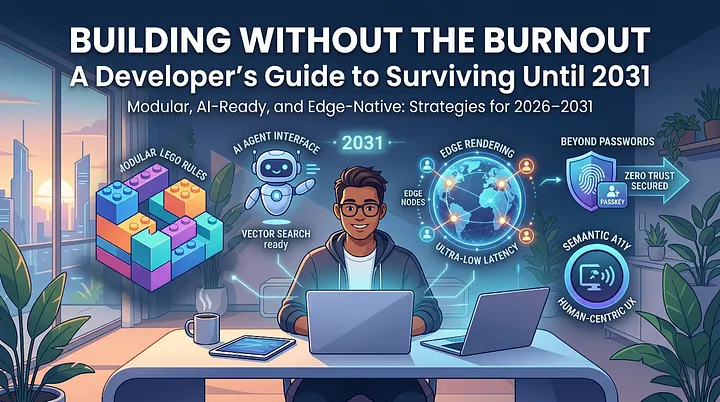
Let’s be honest: in this industry, "five years" is an eternity. If you look back at code you wrote in 2021, you probably cringe. By 2031, the stack we’re using today will likely look like a relic.
So, how do you build something today that won't be a "legacy nightmare" tomorrow? It isn't about chasing every new library on GitHub. It’s about making smart architectural bets that allow you to change your mind later without tearing the whole house down.
1. Stop Building Monoliths
I’ve seen plenty of great ideas fail because they were built as one giant, messy block of code. If you want to last the next five years, you have to keep things modular.
Think of it like this: as a freelance full stack developer for hire, I treat apps like LEGO sets, not stone statues. When a better way to handle payments or search pops up in 2028, you want to be able to just "unplug" that part and swap in something new. Using micro-frontends or serverless functions isn't just a fad; it’s how you make sure your client’s tech doesn’t become a relic.
2. Design for the "AI Agent," Not Just the User
We are entering a time where a human might not even be the one clicking the buttons on your site. More and more, AI agents will be the ones browsing your app to get things done for people.
If your API is a messy tangle of non-standard shortcuts, you’re basically locking yourself out of the future. Staying ready for tomorrow means:
Keep your data clean: Stick to predictable REST or GraphQL.
Get Vector Ready: If your database can’t handle vector embeddings yet, put it at the top of your list. To make your product truly smart, you’ll need RAG (Retrieval-Augmented Generation) sooner than you think.
3. The "Edge" is the New Standard
Remember when we thought "The Cloud" was fast? Nowadays, if a page takes more than a second to load, users think it’s broken.
Moving your logic to the Edge (closer to where the user actually is) is the best way to speed things up. Things like Partial Prerendering change the game. You show the user the basic "shell" of the site instantly so it feels fast, then stream in the dynamic data as it’s ready. It’s all about making the app feel snappy.
4. Security is Moving Beyond the Password
Passwords are an old-school solution for a modern world. Honestly, they’re a liability.
If you’re still making people remember "ComplexP@ssword123!", you’re already behind the curve. Future-proofing means switching to Passkeys and Biometrics. It’s safer for you and much easier for your users. Pair this with a Zero-Trust mindset—something I always prioritize in custom website development services—where you verify every single request, and you’ll sleep much better at night.
5. Don't Forget the "Boring" Stuff: Accessibility
People often treat accessibility (A11y) like a boring chore or a legal hurdle. That is a huge mistake.
In the next few years, as voice devices and AR glasses go mainstream, the "look" of your UI will matter less, and the semantic structure of your code will matter more. If your code is accessible, it’s machine-readable. If it’s machine-readable, it’s future-proof. It really is that simple.
The Bottom Line
At the end of the day, being future-ready isn't about knowing exactly what will happen. It’s about being flexible.
Treating accessibility like a box to check is a bad move. It’s not just about doing the right thing; it’s about making your product smart and ready for anything.
As how we use tech changes, the way your app is built "under the hood"—its semantic structure—will be how everything from screen readers to AI agents understands it. If you build it right, it won’t matter what new gadget people are using; your app will still work.
The Bottom Line
For a remote web developer for startup teams, future-proofing is simply about staying agile. It’s about valuing an architecture that can change over one that is set in stone.
Don't get too attached to one specific framework. Keep your logic at the edge for speed, make your security modern, and build things in small, swappable pieces. If you stick to these basics, then when the "next big thing" hits in 2030, you’ll be ready to grow while everyone else is stuck in the past.
Article SEO Status
Accuracy Score